
Exhibition: The Social Life of Dead Bodies
I drew a star for wishing
A boat in the sea under the sun
Ελπίδα, Αβεβαιότητα
The shape of a human with no certain characteristics,
a blur,
a panic,
bright lights.
Starting in the fog,
where you can only see a little ahead,
searching for the line of truth.
I am inviting you to go on a journey with me. It is a sensitive, informative, and sorrowful one. That is how I experience it. I try to understand what it means for relatives to lose family members. Or to live in uncertainty, not knowing what happened to their loved ones.
Every year, thousands of people arrive as refugees in Europe. Many lose their lives while migrating and fleeing from their home countries. Yet, we understand little about why they died, and how that impacts those who are left behind. It is this lack of attention that has motivated me to create the SOLID project: to investigate the social aftermath of these deaths and disappearances. An aftermath set in motion by the bereavement of survivors and the families of the dead.
In my part of the project, I move between bereaved family members and European forensic anthropologists attempting to identify those who have died. From Heraklion to Lesbos, from the mortuary to the lecture theatre and on to a cemetery in Mytilene, I follow how the identities of the deceased can be restored.
In this exhibition, we turn our attention to the efforts of forensic anthropologists to identify the women, men and children who remain classified as unknown. We provide a human insight into forensic work. Welcome and share this journey with us!
Anja Simonsen,
Associate professor and PI of the SOLID project
This exhibition is positioned between documentation and testimony, communicating the European Research Council-funded project The Social Life of Dead Bodies at the University of Copenhagen.
This exhibition follows the journey of SOLID’s researchers. Through photos from the field, poetry, sound, mapping and installations it offers insight into the lives of people who lose their lives at sea, by shedding light on the work of remembering, identifying, and naming the dead. Contributing with multiple perspectives on forensic identification and insight into the lives shaped by loss.
The project is carried out in collaboration with the Laboratory of Forensic Anthropology and Odontology at the University of Milan, the Department of Forensic Medicine at the University of Malaga and the Forensic Medicine Unit at the University of Crete.
άλλα επιφανειακά αναγνωριστικά // other external identifiers
In this audiovisual installation, Despoina E. Flouri, a Forensic Pathology Resident at the Forensic Medicine Unit in Crete, guides us through the realities of her forensic work when a shipwreck occurs off the coast of Crete. Through visual scenes and personal accounts, we gain insight into the challenges and conditions under which forensic professionals work as they seek to identify migrants missed by their families and help restore their names and identities.
The installation was created by multimodal anthropologist Arendse Reeh and project leader and anthropologist Anja Simonsen during their fieldwork in Crete in the spring of 2026. They created the content in close collaboration with the Forensic Medicine Unit at the University of Crete. It was filmed in Piraeus Harbour, with final editing by graphic interaction designer Jan Aas Sørensen.
The following photos were taken by Despoina E. Flouri, Forensic Pathology Resident at the Forensic Medicine Unit in Crete.
As a Forensic Pathologist, she was asked to take pictures of what she considered the most important part of her work. The photos are highlighting observation, photography, and documentation as a central part to the identification process – using her eyes as a primary tool.
The Collective Poems
The poems I Worked in the Forensic Field, I Drew a Star for Wishing, and Rumiar were written by anthropologist Arendse Reeh. They are based on the stories and conversations that emerged from an ethnographic poetry workshop conducted in Athens in spring 2026.
The workshop was part of the larger event In Search of People: A Co-Creative Workshop on Practices and Methods for Locating Missing People in the Mediterranean developed by the ERC funded research project SOLID.
Some of the workshop participants work in NGOs, associations and research, others have themselves lost or are still looking for their family members, and some are working in the forensic field, assisting with the identification of deceased persons. They all shared their experiences and stories on the matter. This formed the basis for collectively composed poems, reflecting both shared and diverse understandings of loss, disappearance, and uncertainty.
You can read and listen to the poems as you move down through the exhibition.
I worked in the forensic field
I remember one case;
we found a young boy.
I felt like I couldn’t do anything.
Now I’m a mother.
I wasn’t at the time, but I thought about his mother.
Even now, we don’t know who he was.
What about his mother?
What about his father?
But always,
what about his mother?
In our work, we ask:
How can I help?
What happened?
Where did you see them last?
It is a storm of feelings.
You have to separate your personal feelings from the case.
After the work is done, you can’t allow it to go with you,
but it is when you arrive at home that it will hit you.
Grief.
If hope is a colour, it changes:
sometimes green, sometimes purple, sometimes black.
Those who still wait do a ritual.
They will leave the door open
because what if he comes back
and doesn’t have the key?
What if he has nowhere to sleep?
He loved tea,
so I will put the kettle on for him
for when he comes home.
Other people might think it’s useless,
but often this act helps
as a reminder of hope, that he is still alive.
It might be a mistake, the refusal of death.
Can we do another DNA?
Tracing the next step.
Emotion dries out.
I can’t control it.
I can’t know everything.
We can’t control everything. I accept it.
Finally, the butterflies go away, and I can sleep.
I drew a star for wishing
A boat in the sea under the sun
Ελπίδα, Αβεβαιότητα
The shape of a human with no certain characteristics,
a blur,
a panic,
bright lights.
Starting in the fog,
where you can only see a little ahead,
searching for the line of truth.
Rajo, Rajo – Hubanti Laan
When I think about uncertainty,
I’m okay with it because it’s part of my work as an engineer.
But when I think about not knowing the wellbeing of my loved ones,
all I feel is a foggy mind,
a big void.
The future becomes scary
with the possibility
that my loved ones will not be part of it.
حیرة
أمل
عدم الیقین
حیرة
أمل
عدم الیقین
I feel like a bird locked in a cage.
Wishing for the end.
Expecting a phone call, a message, a knock on the door,
the possibility of hope or losing hope with every call.
I feel trapped,
anxious.
I have nightmares.
I’m afraid of the future.
I am afraid of seeking answers.
I want to know,
but I only want to know good things.
A smell and a sound remind me of that person.
My sister loved a song.
For 10 years, I couldn’t listen to it,
but now, when I try to connect to her, I listen.
My sister.
I’m doubting the ones who care, because no one cares.
My sister.
Anger with the world,
with everyone,
feeling uninvolved.
Anger with the system,
borders,
politics.
My sister.
Anger with the family.
We allowed this to happen
to our baby.
My sister.
Guilt.
But hope is a combination of
blue, the sea,
yellow, the sun,
green, the grass.
Black is the colour of disappearance.
Uncertainty is different shades of grey.
Hope is when the shades of grey become their true color.
Where are we going? No one knows.
No choice.
Not seeing anything else
but the journey.
The romantic life of Europe on social media.
They don’t see anything else.
The need to move.
Lack of choice.
Why them and not me?
Why can I enjoy this meal, and not them?
Waiting,
Waiting.
I can’t taste food.
I’m cold.
I’m blind.
You can’t ask a blind man for a colour.
Hope is
new light, something bright in the dark,
but you don’t know if it’s a good thing,
if it is nothing,
or something to fear.
So I’m stuck; not knowing
with no goodbye,
no last hug,
no grave.
The Interview Room
In the early hours of June 14, 2023, one of the deadliest tragedies in the Mediterranean unfolded off the western coast of Greece. The fishing boat later known as the Adriana left Libya on June 9 carrying around 750 people. They were from Pakistan, Egypt, Syria, Afghanistan and Palestine, and for more than four days, the boat sailed aimlessly in the central Mediterranean, headed towards Italy. By midday on June 13, the Greek and Italian authorities, together with the European Border and Coast Guard Agency (Frontex), were informed about a severely overcrowded vessel sailing at low speed in Greek waters. The boat remained under observation for more than fifteen hours before it capsized and sank south-west of Pylos, within the Greek Search and Rescue Zone.
104 survivors were rescued by the Hellenic Coast Guard, while 82 lifeless bodies were pulled from the sea in the following week. Identifying the dead is a slow, meticulous, heart-wrenching process. In the months that followed, the Hellenic Police’s Disaster Victim Identification Unit managed to identify 74 of them. 585 people remain missing to this day. They were men, women, and children. They had families, dreams, hopes and futures. Each of them left behind people who exhausted their options to search for their loved ones. As it bereaved the lives of hundreds of people, the Pylos shipwreck also destroyed entire communities and villages. According to the Hellenic Disaster Victim Identification team, one village in Egypt alone lost around 30 young men who had been
aboard the Adriana.
As part of this project, I follow the work of Greek politicians, the Hellenic Coast Guard, and the Hellenic Police to understand how migration policies move from political decision-making into everyday practice and implementation.
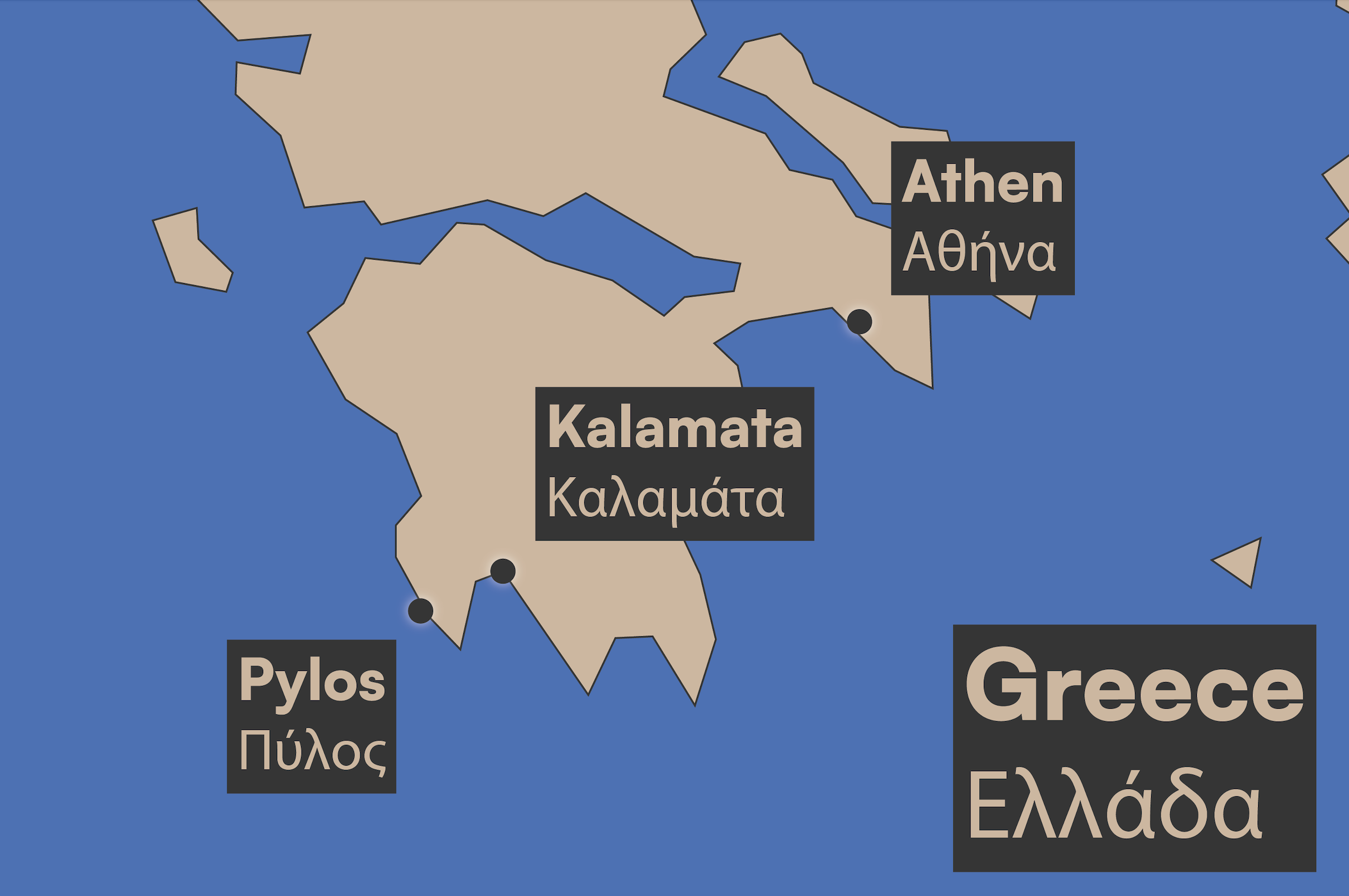
The Interview Room recreates the space where the Hellenic Police’s Disaster Victim Identification team carried out its first interviews with survivors of the Pylos shipwreck. After being rescued, the survivors were brought to a warehouse at the port of Kalamata. This became a temporary shelter where they slept, ate, and waited. In one corner of the warehouse, members of the Disaster Victim Identification team created an improvised interview area using portable privacy screens, often used in field hospitals. They placed three white plastic tables a short distance apart from each other. Two members of the DVI team were seated at each table. Among the survivors, there were four people who spoke English. They were assigned the role of interpreter between the authority and the other survivors. This installation recreates The Interview Room, complete with white plastic chairs and tables. Visitors are invited to sit and read the Interpol DVI questionnaire given to survivors following their rescue from the water.
The work of identifying the deceased and documenting those missing continues long after rescue operations ends and media attention fades away. This installation invites you into the first hours after a shipwreck, which are rarely visible to the public.
Rumiar
I will try to take control
Rumiar
For me it’s the night.
In the day, I can usually keep it at bay.
Not knowing makes me anxious.
Like a wave coming over me at night,
here I’m battling my demons, the terror butterflies.
Always butterflies around my head.
One, two, three
I breathe to take control,
to disconnect my body and my mind.
I can be awake for a whole night.
I feel vulnerable,
not confident,
not secure,
so frustrated.
Trying to look for information
I usually can’t find.
I bring this feeling with me all day.
I also bring this feeling to my house,
to my life.
Rumiar,
your thoughts are going, going, going.
It depends on the circumstances.
If it’s very important, it’s one month.
If it’s not that important, it’s one day.
Breathing makes me calmer:
Still,
I’m a hamster in a hamster wheel.
If I try harder and harder,
I’m going to get the information.
The sense of time disappears.
It shrinks
and it stretches.
You lose the ground you’re standing on.
Open wounds.
Waiting.
Will a body come out,
a dead body?
Is it my imagination?
The colour of hope is green.
For me it’s green because they are hoping they are alive.
That is what it is to be human:
Hoping.
The disappearance of a person
is the worst thing that can happen to a relative.
But in the majority of cases, they are not alive,
but the colour is still green.
Time will stop,
but they can’t grieve,
they can’t go on.
The colour is green.
So I lose my connection to the world.
I feel tired, really tired, mentally and physically,
but also very active; it’s adrenaline.
My heart starts beating.
I can’t hear what people are saying.
I’m overheating.
I need silence, so my mind can stop.
A safe space.
Losing weight.
I don’t eat; it’s perfect in a way.
I forgot to say: I have a headache too; I keep sleeping.
I wish I could meditate,
but I’m in my medication phase.
In the rest of my life, I am absent, thinking about my sister.
It creates uncertainty for those around me.
Where do you go when you disappear?
Did something happen that made you disappear?
Are you waiting for us to find you?
Trajectories of Life, Places of Death
Identifying, Repatriating and Burying the Deceased through Associative Methods
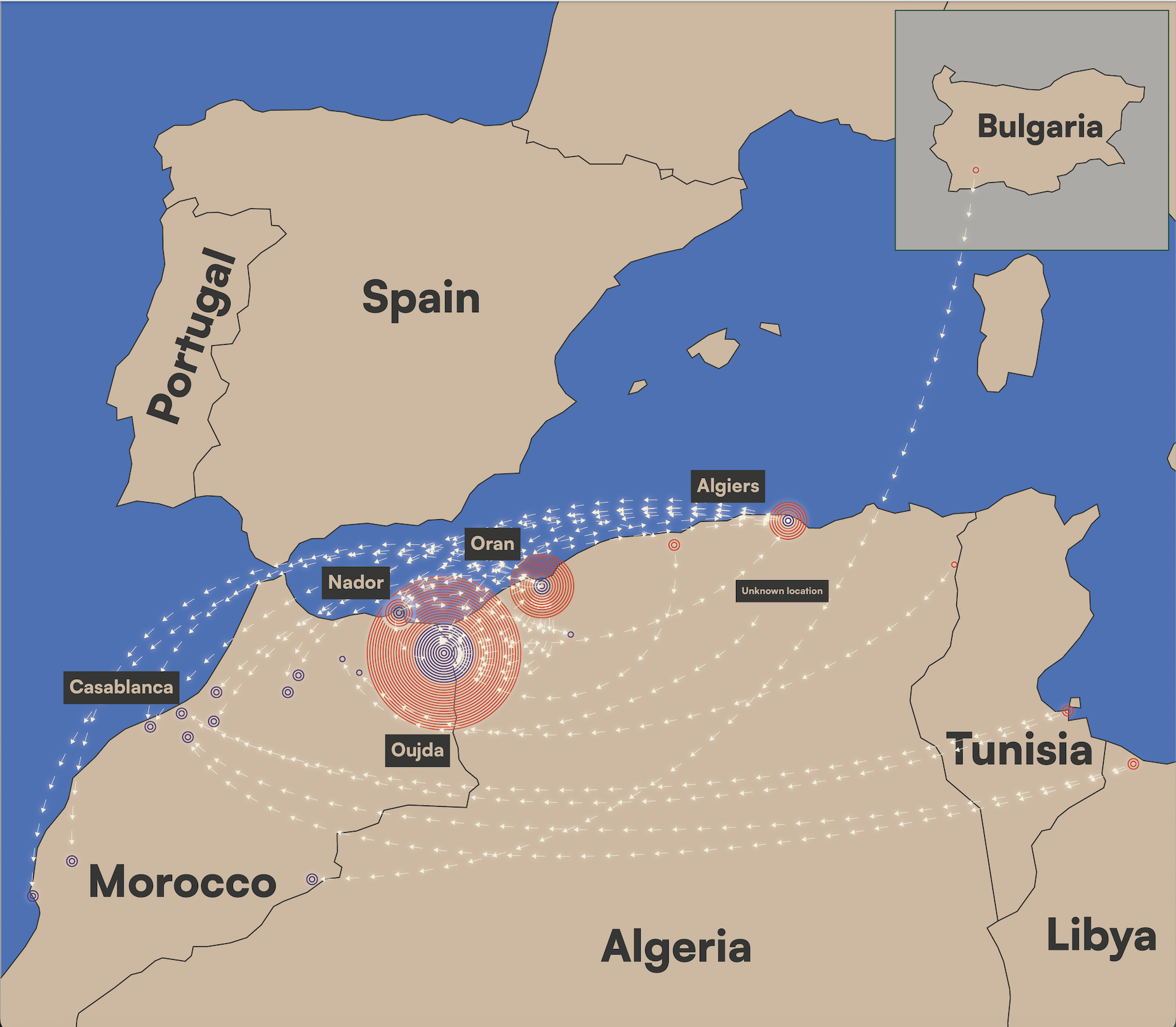
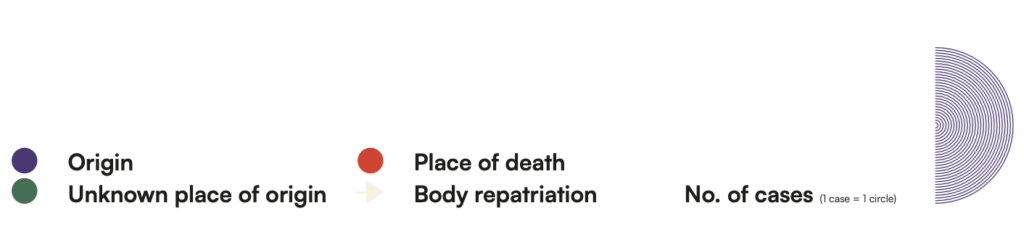
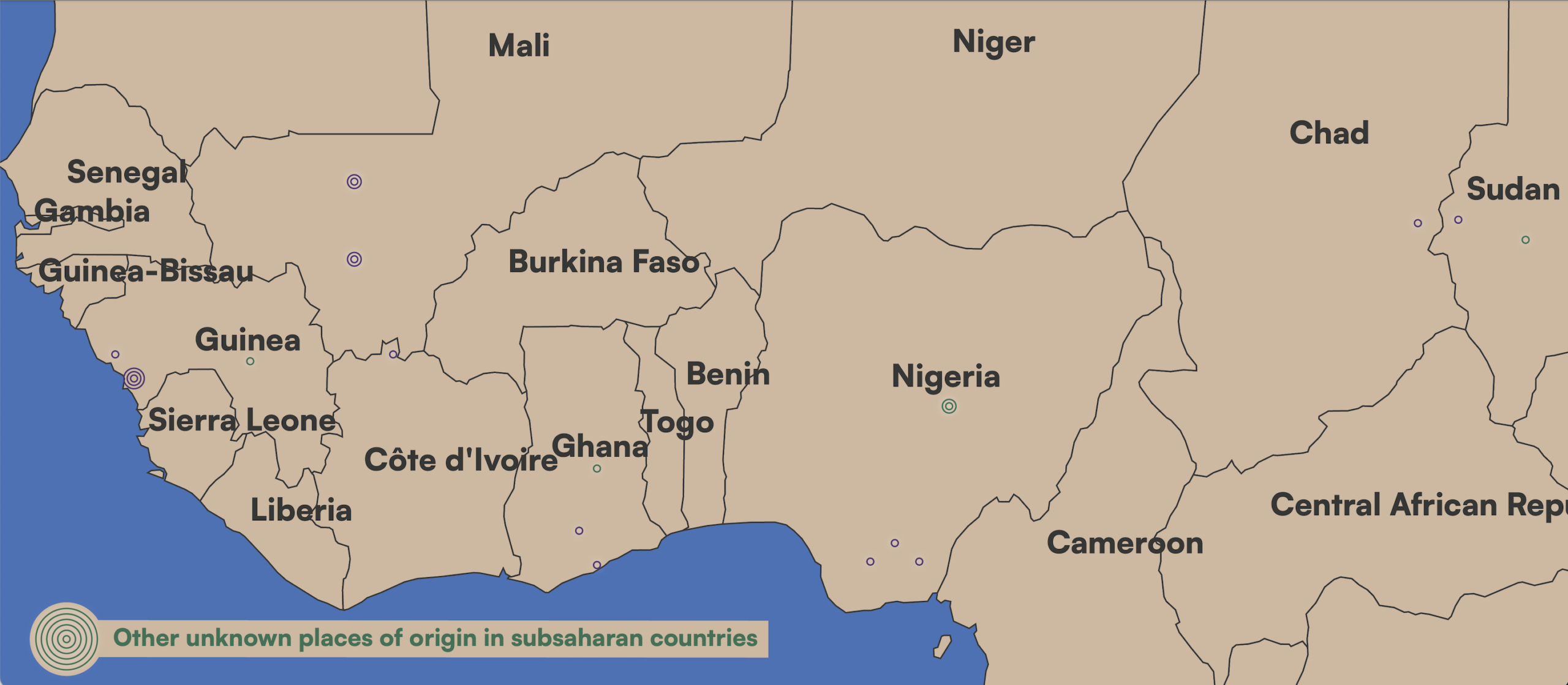
This map shows trajectories of migrant life and their places of death across Sub-Saharan, North African, and European borders. Death does not occur only in the Mediterranean Sea, but also in the Atlantic, the Saharan region, and along the margins of Europe. As border controls tighten, these trajectories are becoming increasingly diverse, longer, and more deadly.
The map was produced using archives compiled by the Moroccan Association for Assistance to Migrants in Vulnerable Situations (AMSV), an advocacy association based in Oujda, near the Moroccan-Algerian border. One advocate has voluntarily archived and handled 62 cases of migrant deaths since 2012. These cases are displayed on the map.
Half of these individuals were successfully identified and repatriated
to their places of origin. Nearly half of the remaining cases were identified and buried at their place of death, mainly in Oujda, in accordance with their faith (primarily Islamic, but also and for five individuals, Christian). Five cases remained completely unidentified, although they were buried in Oujda with the designation ‘Sub-Saharan migrants’ indicated on their graves.
The Moroccan Association for Assistance to Migrants has developed a method of identification that differs with traditional forensic methods but yields significant success. Bybuilding trust and establishing direct contact with morgues, migrant
associations, and families, AMSV conducts an initial visual recognition of the deceased considering factors such as physical characteristics, personal belongings and hidden documents. Working alongside other migrant networks, they frequently locate families of the deceased in their hometowns. Once the identification is confirmed by families, often remotely, AMSV or a referee obtains legal authorisation to proceed with repatriation or burial.
Body repatriation is a costly and complex practice involving multiple administrations. The Moroccan-Algerian border presents a unique geopolitical situation; its land border has been closed since 1994, while direct air links between the two countries have also been suspended since 2021. Families sharing a common language and religion remain split across this divide. Highly controlled and fenced off, this border area is characterized by deep trenches and accounts for an increasing number of deaths.
Families had to pay upwards of 6,500 euros to repatriate a body from Oran to Oujda—a geographic distance of just 230 km—via multi- stop flights through Algiers, Tunis, and Casablanca. However, in 2018 AMSV successfully advocated for the exceptional opening of the land border on humanitarian grounds. Today, the border is opened only for the deportation of migrants or the repatriation of their remains. Meanwhile, families of the disappeared migrants continue to stand at the border, asking deportees for news of their loved ones.
Meet the Researchers
Anja Simonsen is Associate Professor at the Department of Anthropology, the University of Copenhagen. She is working through an interdisciplinary and collaborative approach to research on migration, death and health, currently as the Principal Investigator of the European Research Council Starting Grant the Social Life of Dead Bodies (SOLID).
Arendse Reeh is an anthropologist and documentary artist working across research, media, and the arts. As part of the SOLID project, she explores and contributes with co-creatve, experimental, poetic, and artistic approaches to communicating research.
Gül Üret is a political scientist and post-doctoral researcher – she takes an interdisciplinary approach to exploring how policies are formulated at the highest levels of national governance and how they are interpreted, negotiated and implemented on the ground.
Félicien de Heusch is a socio-anthropologist and postdoctoral researcher. His work deals with the topics of political mobilisation, social protection, and death across diverse contexts of migration in Europe, Africa and America. Within SOLID, Félicien examines how actors such as associations, migrant families, migrant survivors, and forensic experts search for information, and commemorate deceased and disappeared migrants in Morocco and Spain.